Problem
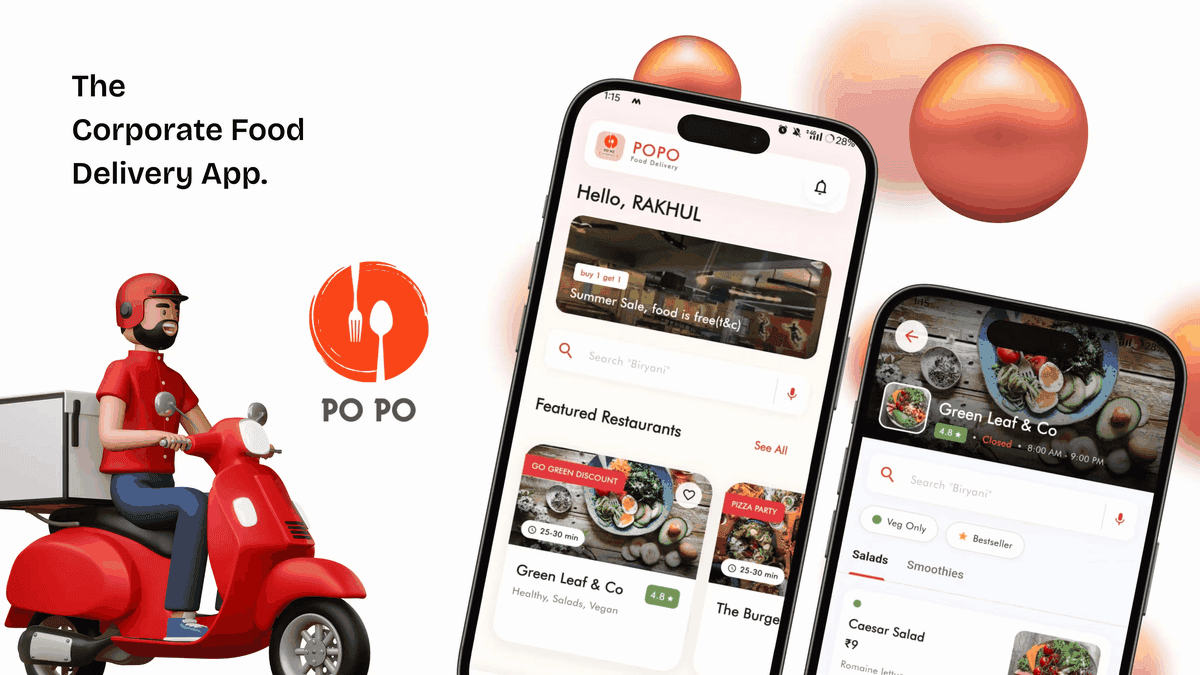
Corporate professionals face unique food-delivery challenges during work hours: limited options near office complexes, peak-hour delays, and no specialized features for workplace ordering. Consumer apps don't address floor/desk delivery, bulk ordering, or office-schedule integration.
The client needed a specialized delivery solution for corporate environments with real-time order tracking, seamless payments, and delivery to specific office locations rather than just addresses.
Constraints
- Reliable on mid-range Android devices (minSdk 21)
- Real-time order tracking with offline fallback
- Secure PayU payment integration
- Corporate-specific delivery locations (floor/desk)
- Low data usage for office network environments
- Fast checkout for busy professionals
- Scalable architecture for multiple restaurant partners
Approach
Built POPO with Flutter, Clean Architecture, and BLoC state management for a scalable, maintainable structure. Real-time order tracking runs through Supabase, payments through PayU, and delivery logistics are optimized for workplace environments.
| Decision | Reason | Trade-off |
|---|---|---|
| Flutter + BLoC | Predictable state flow for enterprise apps | More boilerplate |
| Clean Architecture, feature modules | Separation of concerns, testability | Higher initial setup cost |
| Supabase backend & realtime | Built-in realtime subscriptions and auth | Vendor dependency |
| PayU integration | Corporate-friendly, Indian-market focused | Complex callback scenarios |
| Realtime with polling fallback | Reliability in poor networks | Connection-management complexity |
Hard problems
Real-time tracking on unreliable office networks
Office WiFi destabilizes during peak hours, breaking real-time order updates. Built a hybrid system: Supabase WebSocket subscriptions with intelligent fallback polling. The RealtimeOrderService manages five connection states: disconnected, connecting, connected, reconnecting, and pollingFallback. It switches transport automatically based on network conditions, with exponential backoff and local state caching so no data is lost during outages.
PayU gateway integration
PayU's SDK demands complex hash generation, multiple callback scenarios, and precise merchant configuration. Built a comprehensive PayUPaymentService implementing the full protocol: server-side SHA512 hash validation with salt, callback handling for success/failure/pending states, robust error recovery, and clean staging/production environment switching.
Architecture
- Frontend - Flutter 3.38 (FVM) · Clean Architecture · BLoC · service locator DI · flutter_screenutil
- Backend - Supabase PostgreSQL with realtime subscriptions · Supabase Auth with Google Sign-In
- Payments - PayU Checkout Pro with server-side hash validation
- Services - RealtimeOrderService, PayUPaymentService, UserService, RestaurantService, OrderService
Stats
- ~15,000+ lines across Flutter and native Android
- 20+ RESTful endpoints with realtime subscriptions
- 8+ optimized Supabase tables
- Full PayU production deployment
What I learned
Real-time systems need robust fallbacks in production; payment gateways demand testing every failure scenario; corporate apps carry unique UX requirements; and network resilience is critical in variable connectivity environments.