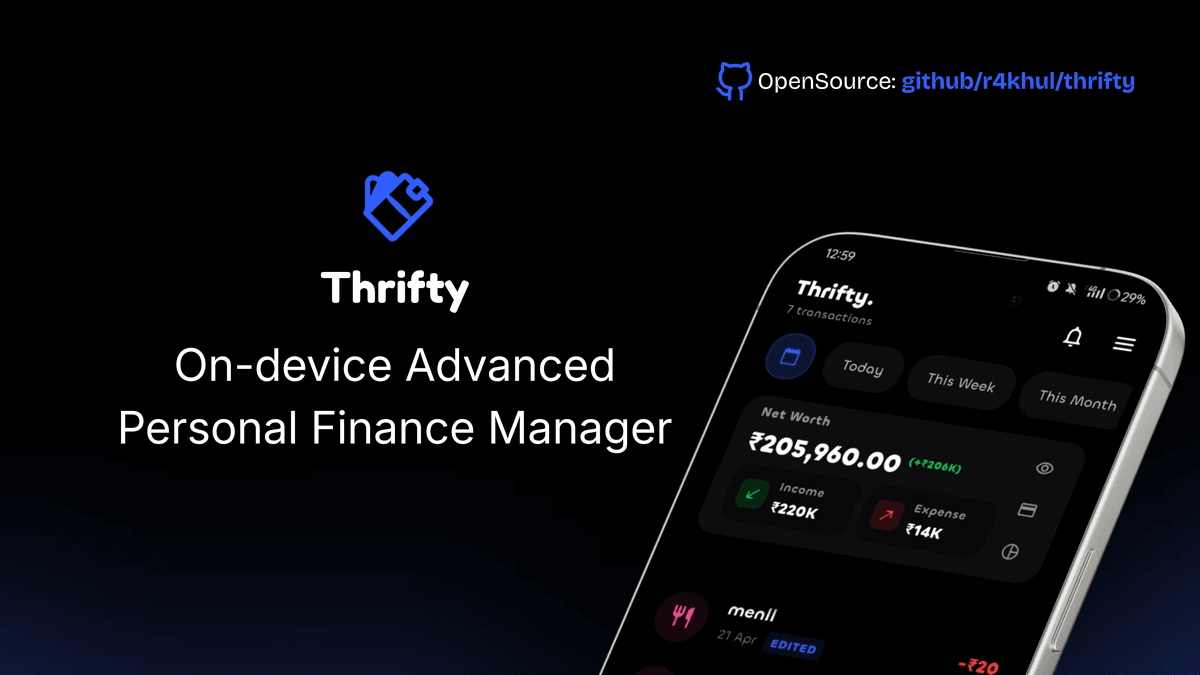
Problem
Personal finance apps typically require constant connectivity, fragment transaction data, and ignore regional language needs. The goal: a finance manager that works offline-first, supports Tamil alongside English, provides real-time analytics, and syncs seamlessly when connectivity returns.
Constraints
- Reliable offline operation on local SQLite
- Secure PIN-based auth with biometric support
- Real-time financial analytics with visual charts
- Background sync with configurable remote endpoints
- Fast transaction logging for daily use
- File attachments for receipts
- Android + iOS
Approach
Built Thrifty with Flutter and clean architecture: Drift ORM for type-safe local persistence, Riverpod for state, and a robust sync mechanism that works with varied backend configurations.
| Decision | Reason | Trade-off |
|---|---|---|
| Flutter + Riverpod | Type-safe reactive state, great performance | Riverpod learning curve |
| Drift ORM + SQLite | Type-safe queries, automatic migrations | Codegen build step |
| Offline-first with sync | Works regardless of network | Conflict-resolution complexity |
| Feature-based modules | Maintainability and scalability | Initial setup cost |
| English/Tamil bilingual | Regional language accessibility | Translation maintenance |
Hard problems
Offline-first sync with conflict resolution
Users modify financial data offline; changes must merge cleanly when connectivity returns. Naive timestamp/last-write-wins approaches lost data. Final design: editedLocally flags with intelligent conflict resolution in the TransactionRepository: sync state management, graceful partial-failure handling, automatic sync triggers, timestamp-based conflict detection, and network-failure fallbacks.
Real-time analytics over large datasets
Category aggregations and live chart updates strained UI performance. Built an analytics engine on optimized queries and reactive state: structured FinancialDataModels feed chart components like CategoryDonutChart with smooth animated updates, backed by caching and lazy loading.
Architecture
- Frontend - Flutter 3.10 (FVM) · Riverpod · GoRouter with deep linking · Material 3
- Data - SQLite + Drift (schema v7, auto-migrations) · 5 tables · Flutter Secure Storage for PIN/tokens
- Sync - REST integration with configurable endpoints · Dio with interceptors · mock-server support (Mockoon, JSON Server, ngrok)
- Services - TransactionRepository, CategoryRepository, AuthRepository, NotificationService, SyncService
Stats
- ~12,000+ lines · 20+ pinned dependencies
- 69 tests · 80.5% code coverage
- Full English/Tamil localization, 50+ strings
- Android (API 21+) and iOS (12+)
What I learned
Offline-first demands disciplined state and conflict strategy. Financial apps need rigorous validation. i18n goes beyond translation: fonts, formats, and culture. Type-safe DB layers eliminate whole classes of runtime errors.