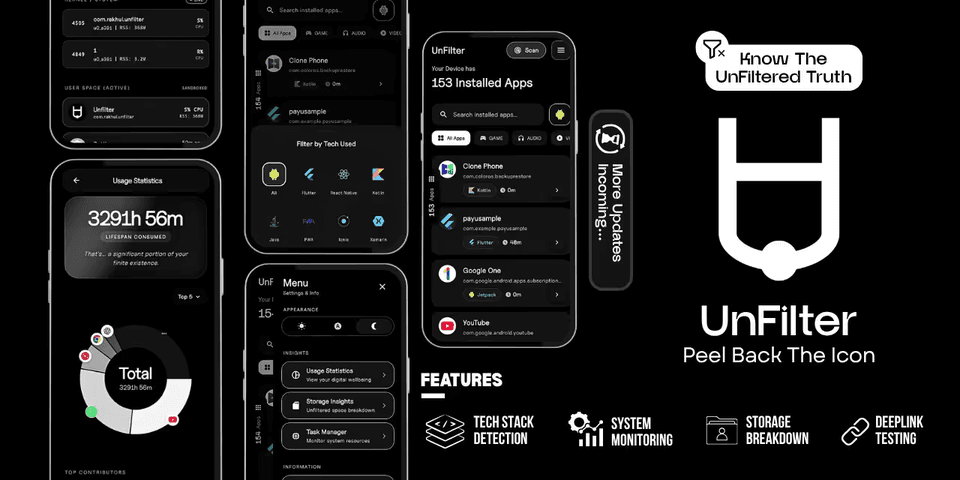
Problem
Modern Android apps are built with diverse frameworks: native, Flutter, React Native, Unity, KMP. But there's no simple, offline-first way to inspect the tech stack behind installed apps along with their runtime behavior and resource usage. Existing tools are developer-only, require root, or depend on online services.
Constraints
- Fully offline, no root access
- Low overhead on system performance
- Compatible with mid-range devices
- Accurate framework detection despite limited OS-level visibility
- Clean UI usable by developers and non-developers alike
- Updates must not depend on Play Store availability
Approach
Designed Unfilter as an offline analyzer that inspects installed packages, infers tech stacks via signature-based detection, and surfaces system insights like memory, storage, and running processes through a clean UI. Architecture cleanly separates package discovery, stack detection, system stats, and update management.
| Decision | Reason | Trade-off |
|---|---|---|
| Offline detection via package inspection | No privacy issues or network dependency | Accuracy bound by known signatures |
| Launch-time re-sync over persistent listeners | Android restricts background listeners | Explicit revalidation instead of realtime |
| Gated OTA updates (GitHub-hosted JSON) | Bypass Play Store constraints, controlled rollouts | Manual version management |
| Flutter + platform channels | Fast UI iteration with deep system access | Complexity at the native boundary |
Hard problems
Detecting installs/removals reliably
Android offers no reliable always-on mechanism without background restrictions or elevated permissions. Implemented a sync-on-launch package re-scan plus a manual "Revalidate" fallback, correctness without violating OS constraints or battery budgets.
OOM crashes on 4GB devices
Intensive scans crashed low-end devices. Fixed with image cache dimension capping via ResizeImage, batched processing limited to 2 concurrent tasks matching the native thread pool, and aggressive cache clearing on widget disposal.
Framework detection accuracy
Obfuscation and diverse build configs break naive detection. Built multi-vector detection combining static, binary, and heuristic analysis over a continuously updated signature database, with confidence scoring and graceful fallback.
Architecture
- Frontend - Flutter 3.10+ · Riverpod · Material 3 with adaptive dark/light theming
- Native - Platform channels · NIO file traversal · PackageManager integration · UsageStats API
- Core - DeviceAppsRepository (TTL caching) · detection engine · performance monitor · OTA update service
- Data - 30+ field
DeviceAppentity · repository pattern · compute-isolated JSON caching · stream-based progress
Stats
- 200+ Active Users (80% Global / Non-Indian · 20% Domestic / Indian)
- ~25,000+ lines across Flutter, Dart, and native Android
- 95% detection accuracy across 10+ major frameworks
- <150MB peak memory, 2-3s scan for 100 apps
- Shipped on Play Store + GitHub releases
What I learned
Design around Android's constraints, not against them. Offline-first tools demand trust in local heuristics and graceful failure. Update systems are product features, not deployment mechanics. Performance is adoption-critical on mid-range devices.